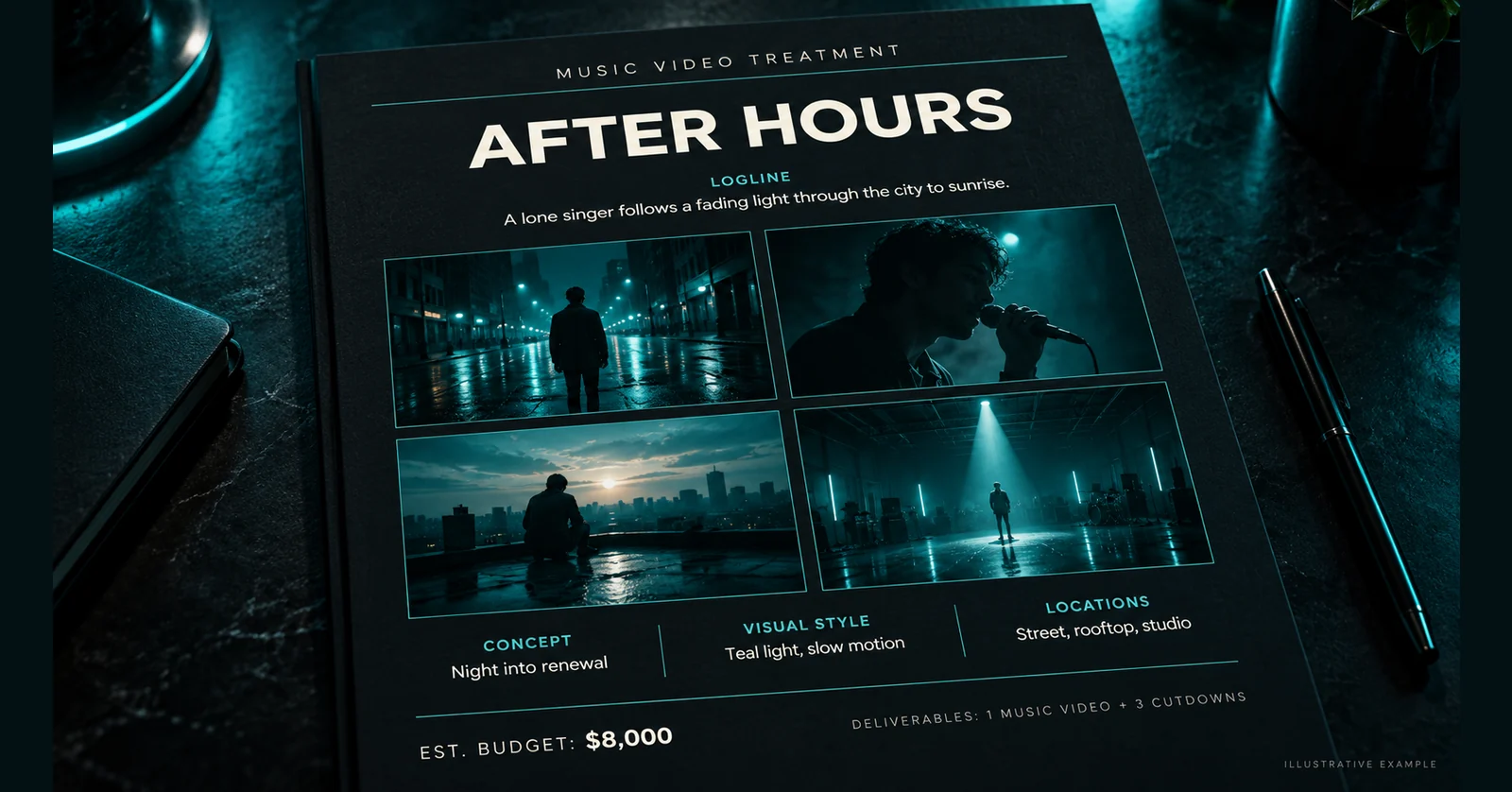
A music video treatment is the one-to-three-page pitch document a director writes to win a music video job: logline, concept, visual style, locations, budget and deliverables. Labels and artists approve it before anything is filmed. This guide covers the seven sections, an eight-step writing process, and what to do once it’s approved.
Introduction
Every music video treatment I write begins as a pitch document that must sell the project before anyone cares about camera angles. The artist reads it, the label approves, and only then does production start.
Think of it as a de-facto agreement. Once a music video commissioner gives approval in writing, the concept, budget, and visual direction are locked. Change them later and you invite frustration across the production team.
Most run one to three pages: a logline, a story summary, a few visual references, and locations. Written concisely and enticingly, that short document becomes the creative roadmap every director and crew member works from.
What Is a Music Video Treatment
A music video treatment is a pitch document, usually one to three pages, where a director lays out the concept, visual style, locations, and narrative before anything gets filmed.
Labels and artists read it to choose a director and approve the spend. The budget, casting and references sit inside so nobody argues about money after the green light.
The strongest ones open with one line, the logline, then expand. I’ve watched a tight outline beat walls of text because the video commissioner could picture every frame in a split second.
Why Write One / Why It Matters
An inquiry rarely arrives polished. A call or email drops a song, a rough idea, and the client is often totally open. The treatment becomes the next step that turns loose information into something executives can approve.
Most briefs go out to competing directors, so the document is the first impression, not the handshake. Whoever makes the storyline and visuals land fastest on the page tends to nab the job, money being equal.
There is also the unglamorous side. A treatment is a paper trail. When a manager later questions a decision, the green light in writing protects you, and it keeps expectations honest before real funders commit anything.
Once approved, the same pages switch jobs. Producers cost it, collaborators you hire read it for pre-production, and everyone on set walks into a smooth shoot because the production process was settled on paper weeks earlier.
Even an independent artist self-funding gains from writing one. Putting the vision down forces choices about scenes and locations early, signals pro status to anyone you approach, and keeps your pitch out of the no pile.
When to Write One
Write it right after the initial conversation, once the budget, timeframe and song are confirmed. Drafting earlier means guessing at the client’s direction; waiting longer wastes a deadline that was probably tight already.
If a label or video commissioner is bidding the work out, your pitch is written first and nothing moves until concept approved lands. Write it then, not once shoot days are already booked.
For an own release in 2026, where Suno supplies the track and an AI music video workflow handles video rendering, you write one later, as a checkpoint before funding your own budget on a locked aesthetic.
Before any writing starts, get the budget confirmed, not implied. The label or video commissioner rarely volunteers a figure, so ask directly, then price it against a crew-location-post split before the concept grows beyond what the deliverables allow.
Client input comes from the initial conversation, so meet with the clients, or at least the artist, producer and management team. Their wants and needs, the timeframe, the deadline, and who holds approval shape every choice you make later.
Then the song itself. Read and re-read the lyrics, map the song’s structure by verses, chorus and bridge, with the runtime. The treatment must sit on the track’s structure, not fight it, so do this homework first.
Structure / Anatomy / Sections of a Treatment
Most treatments I see fail at the logline stage, not the visuals. A one to two-sentence summary should carry the overarching idea in 3–4 words that actually mean something; the rest is a title and song title header.
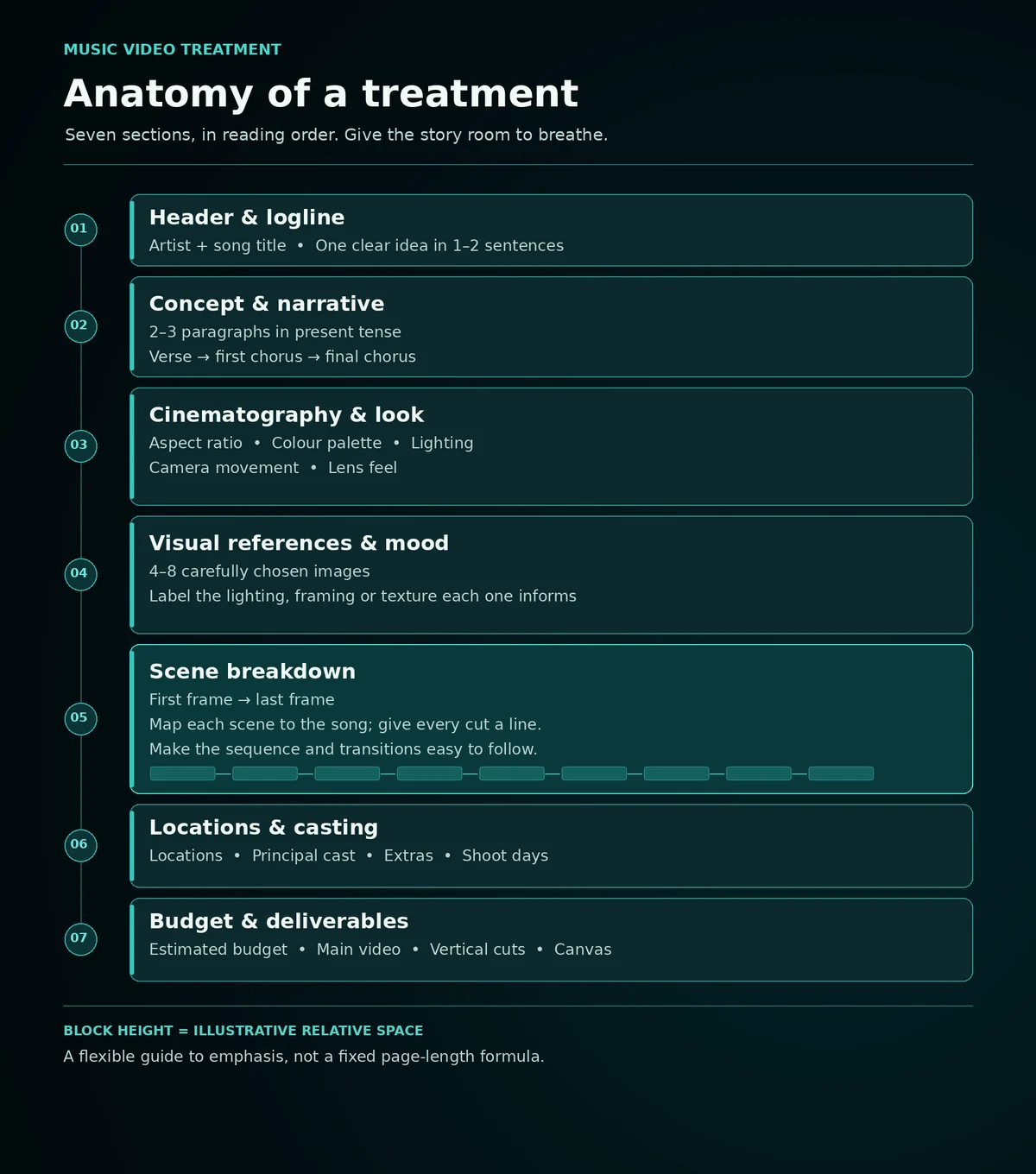
Section two is concept and narrative, written in present tense across 2–3 paragraphs. I map the verse, first chorus and final chorus to beats, because a reader who cannot locate the arc against the song length stops trusting you.
Cinematography and look earns its own per-page spread: aspect ratio, palette, lighting, camera movement and lens feel, each in 3 sentences. Visual references and mood sit beside it, 4–8 images maximum, labelled by what they borrow.
The scene breakdown is where I spend longest. It runs first frame to last frame, and every cut between them gets a line. Locations and casting follow, with extras and shoot days counted honestly.
Budget & deliverables close the document, and a missing budget line is the usual reason nobody will approve the spend. List the verticals and Canvas cuts too. Seven sections, one to three pages, all settled before anything is filmed.
How to Write It: Step-by-Step
Listen before you think. Start by hitting play. Listen to the song multiple times before any concept forms, and sit through a collaborative meeting with the artist so client input shapes the general idea rather than fighting it later.
Compress the idea into a logline. Next, compress everything into a logline: one sentence, present tense, no flowery fluff. If the tone cannot survive that squeeze, the vision is not ready, and directors who skip this stage waste weeks.
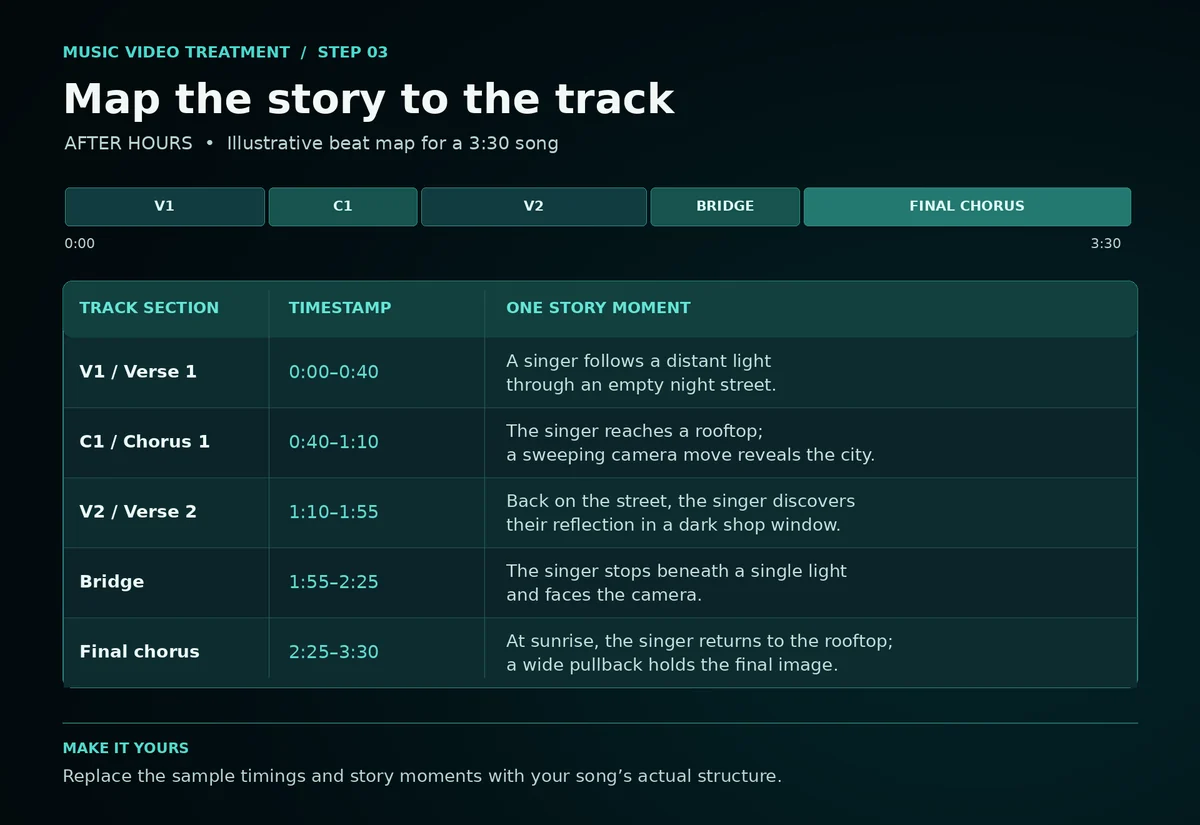
Map the beats to the track. Then map the track into five to eight beats. Each beat gets its own story moment, ordered so the hook lands with the biggest camera moves and the ending scene earns the lasting impression you promised.
Lock the look. After that, lock the look and references. Pull four to eight images, name the color palette, decide 35mm grain or clean digital, and state the aspect ratio early because vertical cutdowns change how you frame every setup.
Break down the scenes. Now write the scene breakdown. Keep locations and casting honest: multiple locations sound ambitious, yet one stage day plus a half-day exterior often delivers more powerful images than a sprawling plan nobody can shoot within budget.
Show the money. Next comes budget and deliverables. Show the coarse split, perhaps 60/25/15 across crew, location and post, list the three 9:16 cutdowns and the 8-second Canvas, and attach budget references so nobody feels tricked financially.
Format for a tired reader. Finally, format it for a tired reader. Bullet points over paragraphs, active voice throughout, zero filler language, and eight slides maximum. Then re-read it the way a label listens: distracted, impatient, and ready to say no.
Submit and archive. Last, submit before the deadline, not after. Labels move fast, and a premium deck delivered yesterday beats a perfect one next week. Track every version in your treatment database so future projects start from proof.
Pro Tips
Tip 1: Treatment First, Storyboard Later
Write the treatment before touching a storyboard. Directors who skip the middle one on small productions still need prose that sells the idea, because a shot list never persuades a label.
Tip 2: Win the First Page
Keep the elevator pitch to two or three sentences on the cover page. Stakeholders deciding between multiple treatments read the summary page first and rarely reach the scene breakdowns.
Tip 3: Map Visuals to the Song
Match the moodboard to the song sections. Pull film stills, photographs and paintings that fit the palette, then tag each visual reference to a specific lyric so lighting logic follows the track.
Tip 4: Always Show the Money
Put a budget section in every pitch, even for a passion project. Record labels greenlit the treatment that showed a verified production cost before the one promising only a cinematic look.
Tip 5: Refresh Every Template
Reuse a fill-in template, but replace the images and touchstones each round. Vet directors can spot a pre-existing template dressed in last year’s colors, and that first impression costs you the gig.
Tip 6: Read Between the Lines
Hunt for hidden elements before pre-production meetings. A home security monitor or interview camera buried in two lines of action can mean additional shooting, extra crew and a shooting schedule nobody planned ahead.
Tip 7: Study, Don’t Copy
Read past treatments from directors like Emil Nava and Hype Williams, then write out the treatment in your own words. Learning from the past beats copying a structure that already won its pitch.
Tip 8: No Pitch Still Needs a Plan
If it’s your own label with an AI workflow, skip the pitch, but still write a scene plan, because a clear concept keeps reference assets and concept inspiration from drifting mid-shoot.
From Treatment to AI Scene Plan
For an own release, the logline, visual style and song timestamps become your brief. Describe the video, optionally add a reference image, then add the track in VlogMe’s Director and edit the proposed scenes before confirming the credit quote.
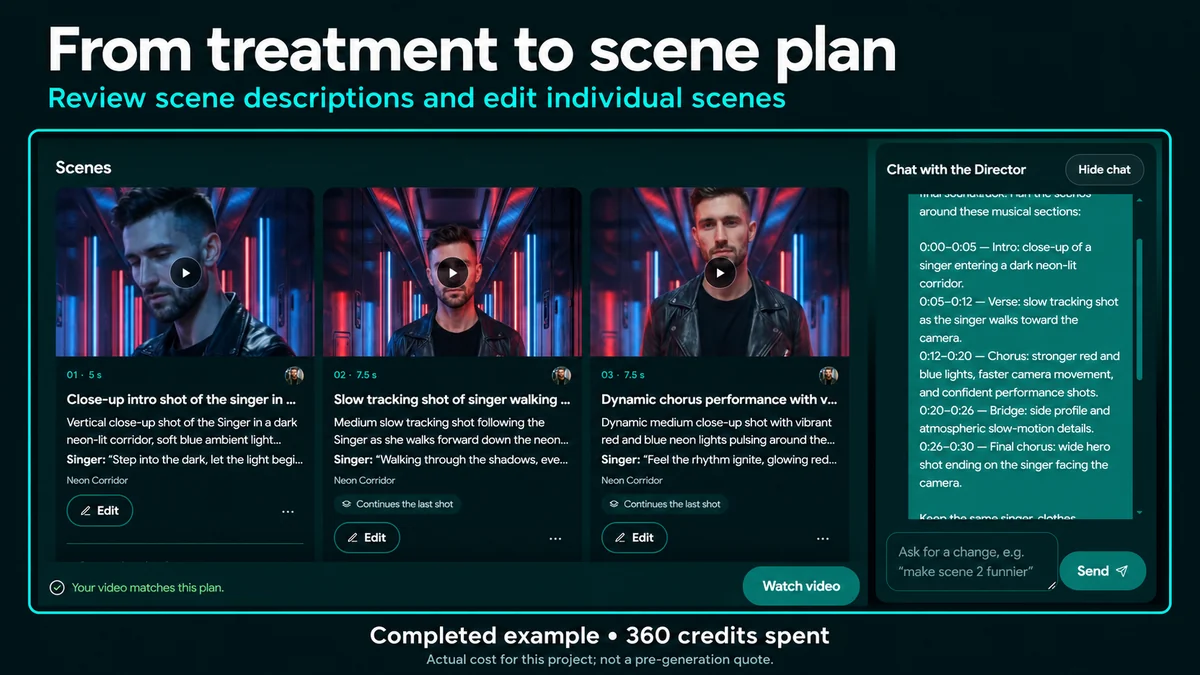
If the treatment is for your own track, start the brief on VlogMe, review the editable scene plan and its credit quote in Director, then download the finished video.
Turn your treatment into a scene plan
Templates
A template is a base file you photocopy for every future project: the title page, synopsis, cinematography & look, locations & cast and shot-by-shot table already sit in general treatment structure order.
What you get here: a seven-section treatment format with fonts locked, one to three paragraphs per block, bullet points for style direction, and example allocation notes showing how much length each section earns.
Download the treatment template
The treatment database version keys every row to song’s phrases: V1, V2, C1, C3, with per-shot timing against 3:12, so a fictional pitch at 2.39:1 already reads like a per-shot plan.
Optional shots, aspect ratios and revision scope sit in a notes section at the end, so a musician on a limited budget can approve the look before anyone books sound-related equipment.
Treat it as a roadmap, not copy-cat models: swap visual references and text and images per song, keep the format and guidelines, and the reusable template stops 20+ page treatments before they start.
Examples / Sample Treatments / Databases
One example teaches more than any guide. Below sits a short rundown, updated for 2026, of the best music video treatments, each a usable model you can study and adapt before your next pitch date.
The River sample, Eminem with Ed Sheeran, is the anchor. The film opens on an empty chair in an interview room, 90’s era camera rolling, visual glitches written straight into the opening paragraph.
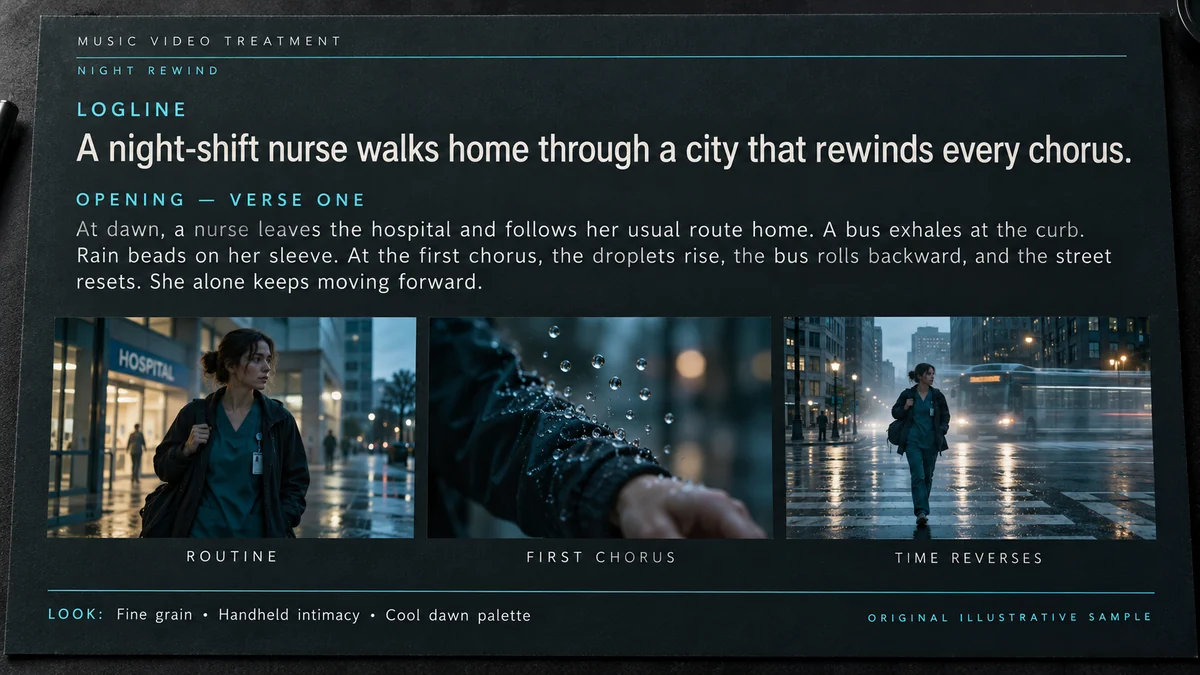
A logline that reads like a sample: a night-shift nurse walks home through a city that rewinds every chorus. Verse one sets the routine, chorus one breaks it, the bridge explains why, the final chorus resolves it.
Notice the coarse split every strong sample shares: a cinematography block naming grain and handheld coverage, a locations & cast page, then one final image the director wants the label to remember.
Older pitchbooks for Kanye West and Red Hot Chili Peppers videos are out there too, mostly images with sparse text. They show how much a label will forgive when the aesthetic is clear.
Study any Riveting Entertainment sample you can find: bullets, not essays, inspired by photographers’ work more than other clips, every page built to save time for a busy executive.
The templates ship with helpful hints in the margins: where the main video idea belongs, how many images per page, what to cut. Swap in your song and win that pitch.
The Importance of Storytelling in the Music Video Treatment
A narrative is the core of the vision in every treatment I write. Without a clear story arc, the end viewer sees random footage; with one, three minutes feels like a short film carrying genuine depth.
Labels read dozens of pitch concepts weekly, so storylines built on thematic revelations make a brief stand out. Study the River treatment for Ed Sheeran and Eminem: its narrative beats sit exactly where the key change lands.
The story also acts as a communication tool keeping every department on the same page. When main characters carry real pain, love, or passion, wardrobe, lighting and cinematography choices stop being arbitrary and start serving the collective vision.
Incorporating Sound Into a Music Video Treatment
Most directors sketch visuals first and treat sounds as decoration. I map the track’s mood shifts early, then let camera language follow what the song for the video does.
Flag music licensing and rights clearance in pre-production, note which beat a voice recording or blackout lands on, and write stillness into the ninety seconds the chorus needs.
Treatment vs. Storyboard vs. Shot List
Across twelve music video production runs, I’ve watched a production team confuse the three working documents. Each executes a different job, arrives at a different point after approval, and punishes the shoot day if ignored.
The 2026 Note: When You Can Skip the Pitch
Spotify Canvas loops, quick social media cuts, or clientele who needed this video yesterday rarely warrant a pitch. Move fast, share concise points in person, save the deck for bigger productions.
After Approval: Turning the Treatment Into a Breakdown
Make the Brief Reviewable
I send the outline to the team with comments switched on — notes, questions, requests for clarification land in one place, so changes stay visible before shoot day.
Know the Material — 1. Read the Treatment
I read the entire treatment twice, slow and thorough, reading between the lines for visual story elements that rushed creatives have overlooked on the first page.
Once the pitch deck is approved, I convert the treatment into script form: each visual moment becomes an action line, properly formatted, with unnecessary words stripped out.
A proper slugline like INT. INTERVIEW ROOM - DAY keeps the formatted script readable, so tagging and highlight work later produces a clean report instead of guesswork.
Externalize It — 3. Translate Words to Actions
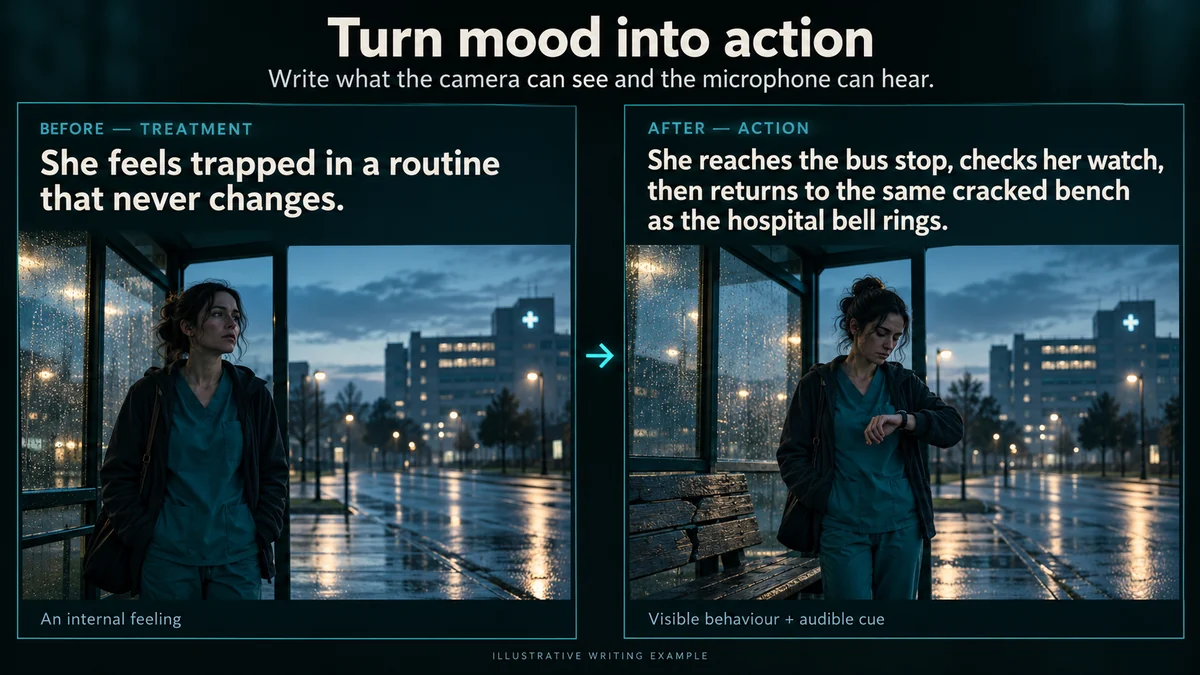
Treatments describe mood in great detail; a breakdown needs literal action. Rewrite every descriptive line as events the camera can record, making the visual medium do the work.
Ask what is audible and what plays on screen. Spoken words become dialogue, atmosphere becomes action lines, and a lack of dialogue signals show vs. tell moments the crew executes.
Script Breakdowns — 4. Break Down the Scene and Identify What’s Needed
A fully broken down scene starts with the script. Read the sluglines, then identify the elements the page implies: cast, extras, scene location, wardrobe, practical props.
Flag special considerations early: visual effects, a night exterior, a ballroom set, dancers. Those lines become tasks on the schedule, with resources priced before anyone promises the entire production.
What You Learn — 5. Finding Hidden Elements in Treatments
A screen within the world is the most common hidden element I’ve seen. Read between the lines to identify it early; that realization quietly reshapes set dressing and budgeting.
Identify Cast and Hidden Characters
On my last shoot, tagged scenes got a character breakdown: every character name, plus the common hidden element — a reflected face on a screen within the world casting forgot.
Conclusion / Landing the Gig
Most treatments I pitched early in my career lost because they read like poetry, not a sales tool. The ones that land gigs are economical with words, to the point, and name a selling point.
Producers rarely say no to a creative vision; they say no to risk. Show the concept is doable, not over budget, and that you’ll pivot early if expectations shift during the pitching process.
Closing the deal means answering the quote question before it’s asked. An independent artist wants a finished video that feels competitive; a label wants proof the idea gets picked up and put into production fast.
Approved treatment in hand, the same brief goes into VlogMe: scenes are proposed in Director for you to edit, the credit quote shows before rendering, and the finished video downloads from Lab.
See the credit quote on your own brief →
FAQs
What is a music video treatment?
A treatment is the written pitch carrying your vision, specific concept, and direction before shooting. Singers, labels, and music video directors use it to align on themes and budget early.
How long should a music video treatment be?
Most winning treatments run one to three pages, succinct, visual-heavy, rarely longer. Labels review dozens weekly, so TMI kills you; support visuals carry the page. One summary page, one reel link, references per section: that’s enough for a professional read.
What sections does a treatment need?
Anatomy rarely changes: logline, concept & narrative, opening sequence, visual arc, then final thoughts. Add lens feel, film grain, and palette notes such as reds and greens. Close with a production plan, budget page, and scene headings for every location.
What’s the difference between a treatment, a storyboard and a shot list?
Three documents, three jobs: treatment sells, storyboard previews, shot list schedules. Storyboards are drawn frames or generated frames showing each camera setup before cameras roll. A shot list is a table grouped by location; skipping it guarantees a chaotic shoot.
Do I need a treatment if I’m not pitching a label?
Still write one; it’s a creative guideline for your crew, not just a sales tool. Self-funded shoots run short on details; a one-page version fixes prepping gaps. Collaborating with editors, VFX, and set-dressed locations gets easier when everyone shares one script.